
I was crouched behind a stack of crates in the warehouse map, heart pounding as footsteps got closer. My paint job was sloppy -- wrong shade of brown, wrong brush size, and I knew it. The seeker walked right past me. Not because my camouflage was good, but because he was scanning for movement, not color. That close call taught me more about blending in than ten rounds of trial and error ever did.
What Is Meccha Chameleon
Meccha Chameleon is a multiplayer hide-and-seek party game where players are split into two teams: hiders and seekers. The twist? Hiders start as blank white 3D characters and must paint their bodies to match the surrounding environment -- walls, floors, crates, bushes, whatever the map throws at them. Seekers patrol the stage with a shotgun, hunting for anything that looks out of place. If you enjoy games that reward creativity, observation, and nerve over raw reflex, this one is for you. It supports up to 24 players per match, with public lobbies, private rooms, and friend invites.
How It Works
The core loop is simple to learn, hard to master. Here is what a typical round looks like from a hider's perspective:
- Spawn in as a plain white character. You have a short preparation window before seekers are released.
- Scout the map for a hiding spot -- a wall corner, a pile of props, a shadowed alcove, anything with a distinct texture you can replicate.
- Use the pipette tool to sample colors and textures from the environment, then paint your body with the brush tool to match.
- Strike a pose that aligns with the surface behind you. Crouch, lean, lie flat -- whatever makes your outline disappear.
- Freeze. Do not move. The seeker patrols the map, and periodic whistle alerts expose your general area. Survive until the timer runs out.
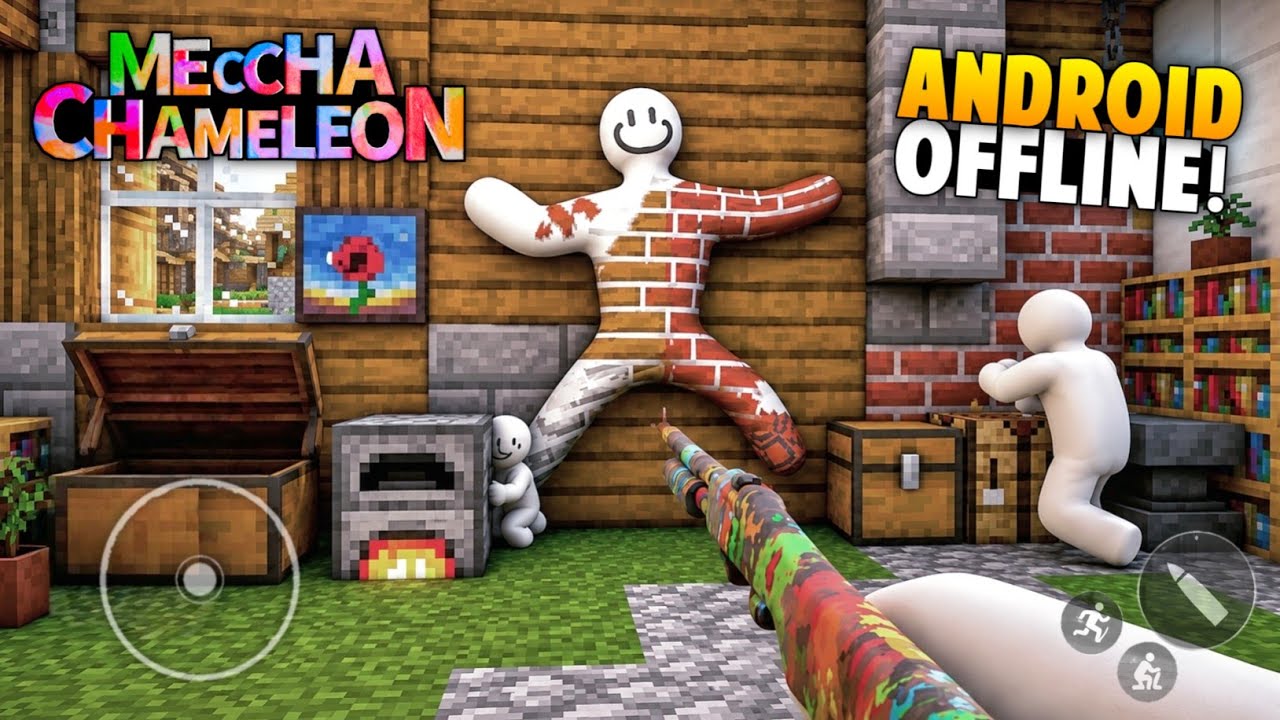
The painting phase: use the pipette to grab colors from the environment, then brush them onto your body before the seeker is released.
Key Features
Free-Form Painting System
This is the heart of the game. You are not picking from preset skins or tapping a "camouflage" button. You manually paint every inch of your character. The pipette tool grabs exact colors and textures from any surface you point at, and the brush lets you adjust size for broad strokes or fine detail work. A brick wall needs red base, gray mortar lines, and maybe a crack or two. A wooden crate needs grain, knots, and shadow gradients. The depth of the painting system is what separates decent hiders from ones who vanish completely.
Pose and Position Mechanics
Paint alone does not save you. After coloring your body, you must choose a pose that makes your silhouette blend with the environment. Crouch against a low wall. Lie flat on a patterned floor. Lean sideways to merge with a vertical surface. A bad pose ruins a perfect paint job because your outline still reads as "human-shaped thing sticking out of a wall." The pose system adds a second layer of strategy that most hide-and-seek games never bother with.
Multiple Game Modes
The game ships with several modes. Classic mode is straightforward: seekers find all hiders before time expires. Infection mode turns caught hiders into seekers, ramping up the pressure as the match progresses. Dual mode splits players into two seeker-hider pairs competing on the same map. Each mode changes how you approach camouflage -- in Infection, you need a disguise that holds up against increasing numbers of patrolling seekers, not just one.
Map Variety
Over a dozen maps are available, each with distinct textures, layouts, and prop distributions. Warehouses with wooden crates and metal shelving. Gardens with bushes and stone paths. Art studios with canvases and paint splatters. Every map demands a different painting approach, and learning the textures of each one is half the battle. The best players know which corners of which maps give them the most natural hiding angles.
Private Rooms and Friend Lobbies
You can create a server, set a password, and invite up to 23 friends for a private match. This turns Meccha Chameleon into a genuine party game -- the kind where everyone is yelling and laughing and someone's terrible paint job becomes the highlight of the night. Public matches are available too, with strangers dropping in and out, which keeps things unpredictable.
Whistle and Footstep Audio Cues
The game periodically triggers a whistle that reveals hiders' general locations to seekers. This prevents matches from stalling out when a hider finds an unbeatable spot. Movement also generates audible footsteps, meaning a hider who panics and repositions mid-round is practically ringing a dinner bell. The audio system creates a tension loop: freeze and hope, or move and risk exposure.
App Screenshots

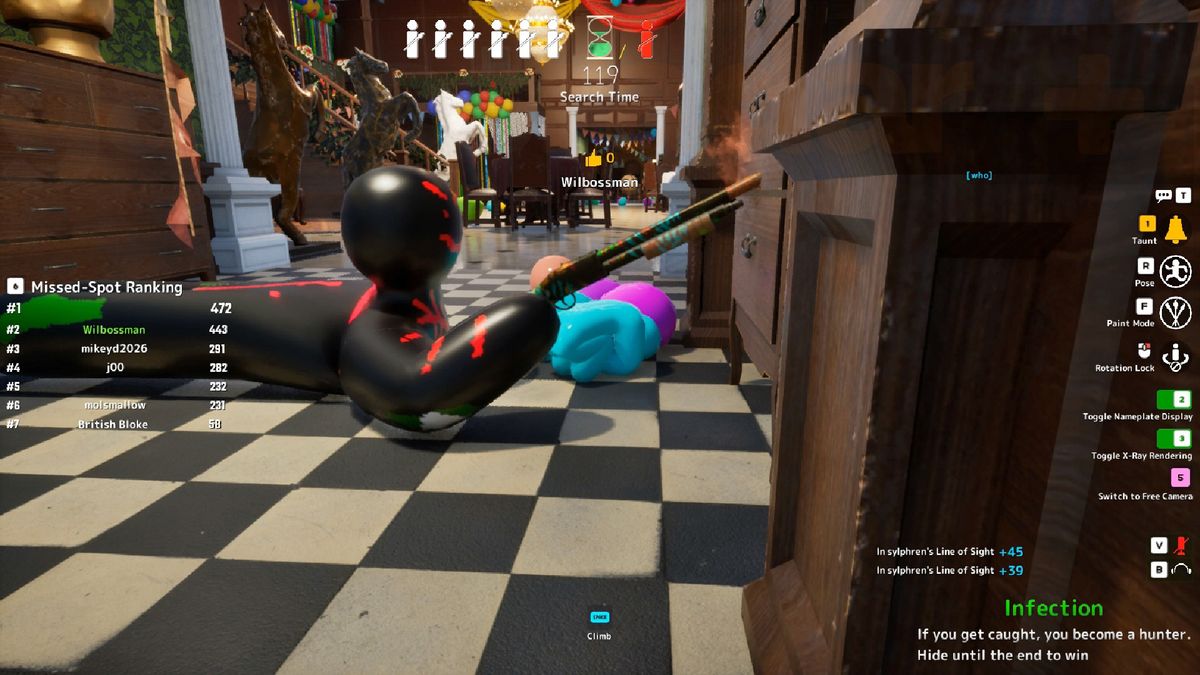
A well-camouflaged hider blending into a garden wall -- the texture match is close enough that a casual sweep would miss it.

Step-by-Step Tutorial: From White Wallflower to Invisible Pro
Here is the fastest path from spawning in blank white to surviving a full round without being spotted:
- Pick your spot before you paint. The most common beginner mistake is painting first, then looking for a place to hide. Do it backwards. Run the map during prep time, find a surface with a manageable texture -- a plain wall beats a detailed mural -- and commit to that spot. Your paint job is only as good as the surface behind you.
- Sample colors with the pipette. Aim at the surface you want to blend into and use the pipette to grab its exact color. Do this for every distinct shade in the area -- base color, shadow tone, highlight. Most surfaces have two or three shades, not one. Grabbing only the base color is the number one reason beginners get caught.
- Paint in layers. Start with the broadest area: use a large brush to cover your entire body with the base color. Then switch to a smaller brush and add the secondary tones -- shadows along your sides, highlights on your chest. Finally, add texture details: mortar lines, wood grain, brick edges. Layering creates depth that a flat single-color paint job never will.
- Match your pose to the surface. If you are hiding against a flat vertical wall, stand straight and press your back against it. If you are hiding on the floor, crouch or lie flat. If you are next to a crate, crouch at the same height as the crate so your silhouette merges. The goal is to eliminate the human outline.
- Freeze and do not touch the stick. Once you are painted and posed, stop. Movement is the single biggest giveaway. The seeker's eye catches motion faster than color mismatch. If the whistle triggers and your zone gets patrolled, hold your breath and hold still. Panicking and repositioning mid-patrol is a death sentence.
- Watch for the whistle timer. The whistle fires on a regular interval. Learn the rhythm. When it is about to fire, make sure you are in position. Between whistles, you have a window to make small adjustments if your paint is smudged -- but move slowly and return to your frozen pose before the next whistle.
- Study seeker behavior. Every seeker has a patrol pattern. Some sweep left to right, others go straight for corners and shadows. In the first ten seconds of a round, watch which direction the seeker moves. Then position yourself on the opposite side of the map or in a spot they have already passed.
- In Infection mode, switch strategies. Once a few hiders are caught, the seeker count doubles or triples. A single-wall disguise will not hold up against three pairs of eyes. Find spots with multiple escape routes or blend into high-traffic areas where seekers move fast and do not inspect closely.
Use Cases
- Party night with friends. Five to ten players in a private room turns this into the loudest, funniest game in your rotation. Someone always botches their paint job, and the reactions are priceless.
- Casual public matches. Drop into a random lobby for quick rounds. The unpredictability of strangers -- both as hiders and seekers -- keeps every match fresh.
- Streamer viewer games. The game is built for audience participation. A streamer can host a lobby where viewers join as hiders, and the chat watches the chaos unfold. The painting mechanic creates natural comedy moments.
- Solo practice against AI. Some maps let you practice painting and posing without the pressure of a live seeker. Good for learning textures and testing poses before jumping into competitive matches.
- Team-building exercises. In a work or community setting, a few rounds of Meccha Chameleon break the ice faster than any structured activity. The shared silliness of painting yourself to look like a filing cabinet is a genuine bonding experience.
- Short-session gaming. Rounds last a few minutes. If you have ten minutes between tasks, you can fit in two full matches. No commitment, no grind, no daily login requirements.
Tips & Tricks
- Use shadows as a second color. Most beginners paint their entire body one flat color. Real surfaces have shadow gradients. Sample the darker shade where the wall meets the floor and paint your lower half with it. This alone doubles your camouflage quality.
- Avoid high-detail surfaces. A plain concrete wall is easy to replicate. A mural with fifteen colors and abstract shapes is a trap. Pick surfaces with two or three tones max, unless you are genuinely skilled with the brush.
- Break your outline. The human silhouette is instantly recognizable. Crouching, leaning, or lying down breaks the "standing person" shape that seekers scan for automatically. A bad paint job with a great pose beats a great paint job with a standing pose every time.
- Hide in plain sight, not in corners. Corners are the first place seekers check. The best hiding spots are open walls where you blend into the background -- spots a seeker walks past without thinking twice. Confidence matters more than concealment.
- Listen for the seeker's footsteps. Audio cues tell you when the seeker is near. If footsteps are loud and close, freeze completely. If they are faint and distant, you have a small window to fix your paint or adjust your pose.
- Do not over-paint. Adding too many layers of different colors makes your surface look muddy and inconsistent. Match the environment's simplicity. A clean two-color blend on a plain wall is more convincing than a messy five-color attempt on a textured surface.
- Watch how other hiders get caught. When a teammate is spotted, note what gave them away. Was it color mismatch? Movement? Outline? Learning from others' mistakes is faster than making them all yourself.
- In Infection mode, blend into traffic. Once there are three or more seekers, corner hiding becomes suicide. They check every corner. Instead, find a wall on a main path where seekers rush through without inspecting. Speed is your friend -- they are moving too fast to study textures closely.
- Practice your brush control. The brush tool has adjustable sizes. Large brushes cover ground fast but lack precision. Small brushes add detail but are slow. Switch between them mid-paint: large for base, medium for secondary tones, small for texture lines. This is the single biggest skill gap between beginners and advanced players.
Pros & Cons
Pros
- Genuinely original concept -- painting your own camouflage is unlike anything else in mobile gaming right now.
- Up to 24 players per match makes it a real party game, not just a 1v1 gimmick.
- The painting system has surprising depth. There is a clear skill curve from "slapped on one color" to "texture-perfect wall mimicry."
- Multiple game modes keep the gameplay loop from going stale. Infection mode especially ratchets up the tension.
- Map variety is solid. Each environment demands a different approach to camouflage, which keeps the game feeling fresh.
- Private rooms with passwords make it easy to play exclusively with friends.
Cons
- The preparation window is short. New players often feel rushed and end up with sloppy paint jobs before the seeker is even released.
- Painting on a phone screen can feel fiddly. The brush precision needed for detailed textures is harder on a touchscreen than with a mouse.
- Network performance varies. If the host's connection is weak, painting can lag, and your carefully applied colors may not show up in time.
- The whistle mechanic can feel unfair when you have found a genuinely clever hiding spot and the game forces you into the seeker's awareness.
- No single-player campaign. The game is built around multiplayer, so if your friends are not online and public lobbies are empty, there is not much to do.
Alternatives / Comparison
| App | Core difference | Best for |
|---|---|---|
| Prop and Seek | Players hide as objects, no manual painting | Players who want simpler, faster hide-and-seek rounds |
| Hide Online | Transform into objects, FPS-style seeker view | Players who prefer action-oriented hide-and-seek |
| Meccha Chameleon | Manual body painting, pose system, up to 24 players | Creative players who want hands-on camouflage, party groups |
FAQs
Is Meccha Chameleon free to play?
Yes, the game is free to download and play. It supports public matches, private rooms, and friend lobbies at no cost. Some cosmetic items may be available through in-app purchases, but the core gameplay is fully accessible without spending anything.
How many players can join one match?
Up to 24 players can join a single match. Private rooms can be set to any number below that cap. Public matches typically fill automatically, though actual player counts depend on how many people are online at the time.
Do I need good painting skills to enjoy the game?
No. The game is fun even when your paint job is terrible -- honestly, the worst camouflage attempts are often the funniest moments in a match. That said, if you want to win consistently, learning basic color matching and layering will make a huge difference.
What is the whistle mechanic and how does it work?
The whistle is a periodic alert that reveals hiders' general locations to seekers. It fires on a timer, so you can learn the rhythm and make sure you are in position and frozen before it triggers. It exists to prevent matches from stalling when a hider finds a spot too good to beat.
Can I play Meccha Chameleon solo?
The game is built around multiplayer, so a true single-player mode is limited. Some maps offer practice options where you can test painting and posing without a live seeker, but the core experience requires other players. If your friends are not online, public lobbies are the way to go.
What is the difference between Classic and Infection mode?
In Classic mode, seekers try to find all hiders before time runs out. In Infection mode, caught hiders become seekers themselves, meaning the seeker team grows over time. Infection is more chaotic and demands a different strategy -- you need camouflage that holds up against multiple patrolling seekers, not just one.
Does the game work on older or budget phones?
The game is designed to run on a range of Android devices, but performance depends on your phone's GPU and RAM. Lower-end devices may experience frame drops during matches with many players, which can affect painting precision. If your phone struggles, try matches with fewer players.
Conclusion
Meccha Chameleon earns its spot on your phone by doing something no other hide-and-seek game does: it makes you the artist of your own survival. The thrill of watching a seeker walk past your carefully painted body -- close enough to touch, far enough to miss -- is genuinely unlike anything else in mobile gaming. Start with plain walls, learn your poses, and do not be afraid of bad paint jobs. The funny ones are how you learn. Grab a few friends, set up a private room, and see who can vanish the hardest. You will know you are getting good when the seekers start complaining that the map is broken.
Safety Note and Disclaimer
Our website is a third-party distribution and information site, not the official app store or the app developer.
Download only from a source you trust and verify the source.
Review the permissions the app requests and decline anything that looks excessive.
Keep your device's security settings and antivirus up to date.
Prefer official stores (Google Play) when the app is available there.
This article is an independent overview and is not affiliated with the app's developer.